
A GEO strategy (Generative Engine Optimization) is a coordinated set of analyses and interventions designed to improve the visibility, understanding, and citability of a brand in generative engines and AI answers, such as those produced by ChatGPT, Gemini, Claude, Copilot, and Perplexity.
A GEO strategy is therefore not a matter of applying a simple checklist of techniques. It starts from an analysis of the brand and its digital ecosystem, identifies the weaknesses that may limit its presence in AI answers, establishes priorities, and defines the interventions most likely to improve recognisability, authority, and the ability to be used as a source.
This is where the GEO audit becomes the starting point of the strategy. The audit gathers data and identifies gaps; the GEO strategy interprets them and turns them into concrete actions. Depending on the issues detected, interventions may involve:
- accessibility and retrievability of information;
- structure, clarity, and quality of content;
- entities and semantic relationships;
- structured data and the Knowledge Graph;
- authority and presence in external sources;
- relevant mentions, citations, and backlinks;
- brand presence in the answers of AI engines.
The move from the GEO audit to the GEO strategy therefore becomes a continuous process:
Audit → Diagnosis → Priorities → Strategy → Intervention → Verification → Monitoring
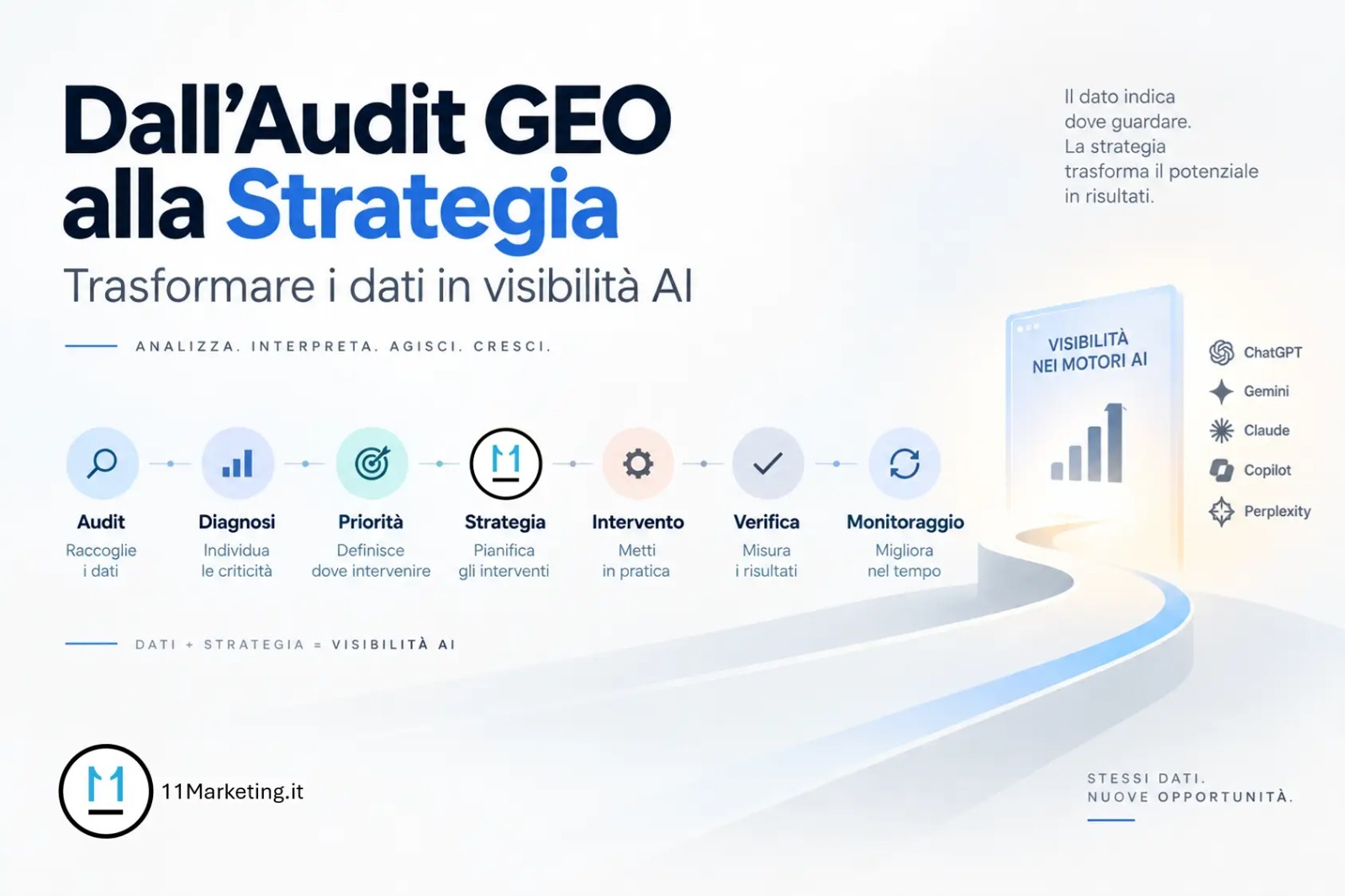
The GEO audit helps identify where to intervene; the GEO strategy establishes how to intervene, with what priority, and toward what result.
GEO audit: spotting a problem is not the same as solving it
A GEO audit can surface very different issues. A site may be technically accessible to AI crawlers yet have content that is hard to retrieve. A brand may be clearly described on its own site yet have few external authority signals. Another may be recognised when searched for directly, yet rarely appear in answers to informational or discovery queries.
These are different situations and, precisely for that reason, they call for different strategies. The result of an audit should therefore not be read as a simple list of tasks to execute, but as a diagnostic baseline from which to set priorities.
The useful question is not only “Which GEO activities should I carry out?”, but above all “Which weakness is limiting the brand’s presence in AI answers the most, and which intervention can have the greatest impact?”
From diagnosis to operational priorities
The GeoSonar framework organises GEO analysis around three broad areas:
- Infrastructure: the ability of systems to reach, read, and interpret the site;
- Narrative: the clarity, completeness, consistency, and usability of information about the brand;
- Authority: external signals such as mentions, citations, reviews, backlinks, and third-party sources.
This distinction helps avoid one of the most common mistakes: applying the same GEO strategy to every project.
If the infrastructure is already solid, continuing to concentrate resources on technical aspects may have marginal impact. If the main problem concerns authority, it may be more useful to work on the brand’s presence within sources relevant to its sector. When the weakness concerns the narrative, improving the structure, clarity, and completeness of content may become the priority.
The diagnosis, then, indicates where the problem sits. The strategy establishes how to address it.
The three questions to ask after a GEO audit
Once a weakness has been identified, it is worth answering three fundamental questions before intervening.
1. What is the problem?
The first step is to pinpoint precisely the signal or area where the gap sits. Some examples:
- low presence in discovery queries;
- few citations in AI answers;
- weak presence in external sources;
- content that is hard to retrieve;
- poor clarity of the brand entity;
- incomplete or poorly structured information.
The more precise the diagnosis, the more targeted the intervention can be.
2. Why does this problem limit presence in AI?
Data must be interpreted within its context. Having few backlinks, for example, does not automatically mean there is a GEO problem. You need to understand which sources are genuinely relevant, which recur in your information ecosystem, and what relationship exists between those sources, the brand, and the topics you want to be recognised for.
The same principle applies to content, structured data, entities, reviews, citations, and other signals. Data gains value when it is interpreted in the context of the project.
3. Which intervention takes priority?
Not all activities carry the same weight, and not all of them need to be carried out at once. An effective GEO strategy should therefore assess:
- severity of the issue;
- potential impact;
- priority of the intervention;
- resources required;
- actions to be taken;
- how results will be measured.
This makes it possible to move from a logic based on the quantity of activities to a strategy grounded in their actual usefulness.
From presence to brand visibility, understanding, and citability
One of the most important aspects of Generative Engine Optimization is understanding that being present online does not automatically mean being used by AI systems.
To increase the chances of entering the retrieval and generation process, a brand should be able to be:
- found, through accessible content and sources;
- understood, thanks to clear and consistent information;
- contextualised, through recognisable entities and relationships;
- retrieved, when the information is relevant to a request;
- used, when that information proves useful in constructing the answer;
- cited, when the system considers it relevant to attribute or indicate the source.
These steps are connected. A site that is technically accessible but semantically unclear can be reached without being correctly interpreted. In the same way, a brand described perfectly on its own site but barely present in independent sources may find it harder to build external signals of authority and recognisability.
This is why a GEO strategy must consider, at the same time, the brand’s visibility in AI engines, its comprehensibility, and the ability of generative systems to retrieve and use the information about it.
GEO strategy works on relationships, not on isolated signals
GEO should not be read as a collection of isolated techniques. Content, entities, structured data, the Knowledge Graph, external sources, backlinks, citations, and authority gain value above all through the relationships they help build.
Imagine a company that wants to be recognised as a specialist in a particular service. Repeating that claim across its own site is not enough: it needs consistency between the elements that describe and confirm that identity.
The relationship might be represented like this:
Brand → Services → Skills → People → Content → Topics → Sources → Citations
A coherent network of relationships helps clarify the context in which the brand should be interpreted. This is why a GEO strategy can involve work on the owned site and external activity at the same time.
Content written for people and usable by AI
Writing for generative systems does not mean producing artificial text built exclusively for machines. Good GEO content should first and foremost answer a human information need effectively, but it should do so through information that is also easy to locate and use.
Effective content should therefore be:
- clear and comprehensible;
- contextualised;
- well structured;
- concrete and verifiable;
- easy to retrieve;
- self-contained enough to be understood even when extracted from the broader context of the page.
An important answer buried inside hundreds of loosely relevant words may prove less usable than the same information expressed clearly and in context.
The goal is therefore not to choose between writing for people and writing for AI, but to narrow the distance between what is useful to a person and what can be understood, retrieved, and used by a generative system.
Structured data and entities: giving information context
Another area of intervention concerns the representation of entities. Schema.org and JSON-LD can help make explicit, in structured form, information and relationships already present on the page, but they are not a shortcut to visibility or citations.
Adding markup without a semantic strategy often means describing, in structured form, information that remains unclear upstream.
For this reason, the order of the questions should be:
- Which entities do we want to make comprehensible?
- What relationships exist between these entities?
- Does the information on the site already make those relationships clear?
- How can we also represent them through structured data?
Person, organisation, service, product, place, skill, author, and content can then be connected within a more coherent representation of the brand.
Authority: what a brand says about itself is not enough
A GEO strategy must also look beyond the owned site, because generative systems operate within far broader information ecosystems.
Independent sources, vertical sites, media, communities, reviews, citations, and mentions can help create external confirmation of what the brand claims on its own domain. The objective, however, should not simply be to obtain more backlinks or to increase the number of mentions indiscriminately.
The strategic question becomes: which sources genuinely contribute to building the brand’s entity and authority in the context in which it wants to be recognised?
A relevant presence within sources closely tied to the sector can carry very different strategic meaning than numerous mentions from contexts with no relationship to the topic.
GeoSonar and Eleven Marketing: from diagnosis to GEO strategy
It is precisely in the passage between measurement and intervention that technology and strategic expertise can work together.
GeoSonar provides a diagnostic baseline for analysing the project, identifying weaknesses, defining priorities, and monitoring how they evolve. Eleven Marketing, an agency specialising in SEO, GEO, and AI visibility, uses that information within a strategic path that can involve content, entities, information retrievability, structured data, authority, and brand citability.
The goal is not simply to raise a GEO score, but to understand which interventions can help improve the brand’s visibility in AI engines and build, over time, a clearer, more recognisable, and more authoritative presence within generative ecosystems.
The two roles can be summarised simply:
- GeoSonar → diagnosis, data, priorities, and monitoring;
- Eleven Marketing → interpretation, strategy, and GEO interventions.
Data helps you understand where to look; strategy lets you decide how to intervene.
GEO training: from skills to application
Alongside its strategic work, Eleven Marketing Formazione offers GEO courses for improving visibility in generative engines, designed for companies, professionals, and teams that want to understand and apply Generative Engine Optimization. The training covers topics such as AI visibility, content, entities, the Knowledge Graph, structured data, retrievability, and citability, with a practical approach aimed at turning principles and data into strategies applicable to real projects.
From intervention to measurement
A strategy does not end when a page is edited, a markup implemented, or a new citation obtained. After the intervention, you need to verify what has actually changed.
The process therefore becomes:
Audit → Diagnosis → Priorities → Strategy → Intervention → New audit → Monitoring
If a technical issue is corrected, a new crawl can verify that it has been resolved. That, however, represents only the first level of measurement.
The second consists of observing whether, over time, that change also contributes to shifting the brand’s actual presence in the answers of generative engines. The two measurements should not be confused: correcting a problem does not automatically and immediately produce greater AI visibility.
A fix can be verified quickly, whereas effects on visibility may take longer, because they also depend on the processes through which different systems retrieve, interpret, and use new information.
GEO is a process, not a checklist
The real evolution of Generative Engine Optimization lies in moving from a logic based on individual activities to one based on objectives and results.
This means changing the way questions are asked:
- not only “Have we added Schema.org?”, but “Are the important entities sufficiently clear?”;
- not only “Have we obtained backlinks?”, but “Is the brand present in the sources relevant to the context in which it wants to be recognised?”;
- not only “Have we optimised the content?”, but “Is the information comprehensible, retrievable, and usable?”;
- not only “Have we done GEO?”, but “Is the brand’s presence in generative systems changing?”.
It is this difference that turns GEO from a set of activities into a measurable AI visibility strategy.
From diagnosis to action
A GEO audit is therefore the starting point, not the finish line. Data reduces uncertainty and identifies the areas worth focusing on; strategic expertise interprets those signals and turns them into a plan of action.
The path becomes progressive: understand, diagnose, prioritise, intervene, verify, and improve.
When technology, data, and strategy work together, it becomes possible to approach GEO not as a series of attempts or a checklist of tasks to complete, but as a process in which every intervention starts from an identified weakness and can subsequently be verified and measured.
Have you already run a GEO audit and want to turn the data into an operational strategy?
Discover Eleven Marketing’s approach to SEO, GEO, and AI visibility, and how to turn the weaknesses identified by an audit into interventions aimed at the brand’s visibility, understanding, and citability in generative engines.